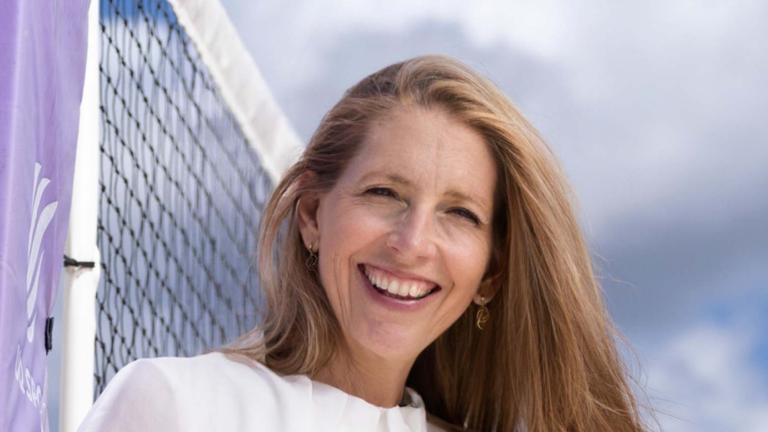
On the final day of the IF Forum 2025, FIVB President Fabio Azevedo took part in the Sustainability Leadership in Action session, marking the FIVB’s debut on the panel. The fireside chat, moderated by seasoned journalist and the IF Forum Master of Ceremonies/Moderator David Eades, also featured Ms Petra Sörling, President of the International Table Tennis Federation (ITTF) and IOC Member. Together, they shared their personal experiences, insights and approaches to driving sustainability in sport.
The discussion explored the leaders’ journeys in understanding and addressing the urgent challenges posed by the global climate crises. Questions centred on when the sport leaders first recognised the impacts of environmental change on their sports, how this shaped their leadership and what concrete steps are being taken to create meaningful and lasting change.
Reflecting on his own leadership journey, President Azevedo spoke candidly about his early realisation of the gravity of the climate crisis and the responsibility of sports leaders to act decisively.
““Sports leaders are elected to serve the sport and to be the guardians of the brand for a certain period of time. And we believe that our mission as leaders is to leave our sport better than we found it,” he said. “When we began preparing the FIVB Strategic Vision 2032, I recognised that I didn’t have enough knowledge on climate change. And I encourage everyone to stop calling it climate change actually, we need to call it a climate crisis or climate emergency…I invited a specialist to educate me and our team at the FIVB so that we could truly understand the issue. It is a problem of humanity, and it is our responsibility to act for the next generations.”
In just eleven months, the FIVB has made significant strides in integrating sustainability into its operations. This includes the appointment of a Head of Development & Sustainability with more than two decades of experience in the industry, and the implementation of environmentally responsible practices within Volleyball House, such as the elimination of plastic bottles.
Over the past year, the FIVB has also signed two major frameworks, further embedding sustainability into its governance and daily operations. The Sports for Nature framework was signed in Palau in July, in the presence of Baklai Temengil, President of the Oceania National Olympic Committees (ONOC) and Member of the International Olympic Committee (IOC). The framework saw the FIVB take a decisive step in its sustainability journey, becoming part of a growing global movement to protect and restore biodiversity through sport. Moreover, the UN Sports for Climate Action Framework was signed in October by the FIVB President alongside volleyball and beach volleyball athletes, in the presence of IOC President Kirsty Coventry.
During the IF Forum panel, President Azevedo emphasised that sustainability starts with leadership by example.
“Leadership is everything. If we do not lead by example, people will not follow. For example, I now drive my personal car which is 100% electric. Going in a sustainable direction has no downside, {it’s the right way forward}.”
He also praised initiatives that encourage individual responsibility and demonstrate a pledge/commitment to positive change. Azevedo shared an inspiring example from earlier this year:
“I love the idea of a pledge, it’s a symbol, it’s so powerful. When we went to Palau for the Pacific Mini Games with Julie {Duffus, Head of Sustainability for the IOC}, I saw something beautiful – a full-page pledge stamped into every visitor’s passport, asking them to leave the country better than they found it…I encourage every International Federation to take similar responsibility {on sustainability}. This is not about belief; it is about our responsibility.”
Looking to the future, President Azevedo outlined the FIVB’s commitment to using volleyball’s global platform to inspire environmental action and awareness.
“Sport has the power to bring people together. Through our athletes and our events, we can deliver the right messages to the world and inspire more people to be engaged,” he said.
The FIVB is currently exploring new initiatives to raise awareness about climate challenges in particularly vulnerable regions, such as Oceania. Among these initiatives is a beach volleyball event that will see athletes sail around the Pacific, combining volleyball competition with a strong message of environmental responsibility.
As the IF Forum 2025 concluded, President Azevedo reaffirmed the FIVB’s belief that sustainability is a journey that requires action, education and leadership at every level.