Sustainability spans economic, social and environmental fronts – and sits at the heart of the FIVB Strategic Vision 2032. In 2025, turning that vision into reality became more prominent than ever.
Building on the FIVB’s first-ever sustainability event reports for Volleyball Nations League events in 2025, covering Ljubljana, Łódź and Ningbo, more have now been published for events in 2025 – the Beach Pro Tour Elite 16 in Hamburg (Germany), the FIVB Beach Volleyball World Championships in Adelaide (Australia) and the FIVB Women’s Volleyball World Championships in Thailand.
Marking a milestone under Point 9 of the Strategic Vision 2032 and the FIVB Sustainability Pledge, the reports are delivering something concrete: real data, real measurement and a clearer picture of where volleyball can make the most difference.
Each event brought their own approach – shaped by local partners, local conditions and local communities. Together, they demonstrated that major sporting events can have a genuinely positive impact on the places that host them.
Hamburg
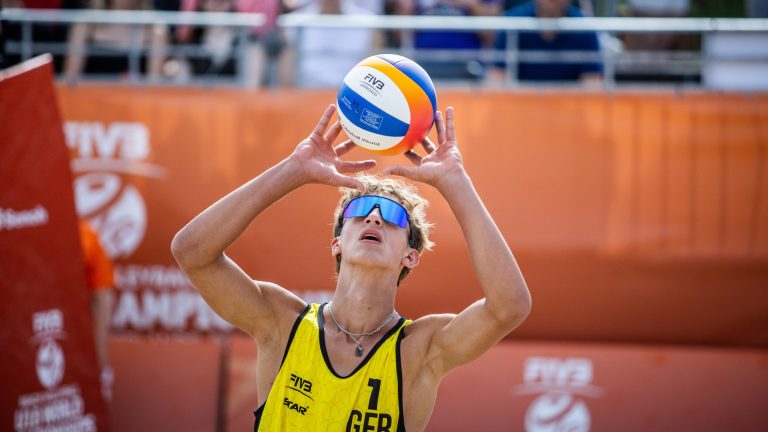
When the Elite 16 came to Hamburg, the Local Organising Committee, its partners and the FIVB worked hard to ensure the competition made an impact off the court as well as on it. Dedicated ticket allocations went to German Volleyball Federations, bringing local clubs, coaches, young athletes and officials closer to the sport. Meanwhile, 250 local fans volunteered across guest services, match operations and event promotion, while a junior club team played in the rehearsal match and a beach volleyball clinic was held for the volunteer group – moments that showed how volleyball can have a genuine positive impact on its community.
Water supplier Viva con Agua was chosen with purpose. The mineral water is sourced from a local German well, and its extraction and transportation are fully climate neutral. Athletes and staff returned bottles for reuse after matches, keeping single-use plastic out of the waste stream as part of a wider circular system.
When the last athlete had stepped off the court, the sand did not go to waste either. It was transferred to a local golf club – a simple, smart decision that kept a usable material in circulation and out of a waste bag.
Adelaide
The Beach Volleyball World Championships arrived in Adelaide with a clear target: divert 80% of waste from landfill. The final figure was 83%.
Waste contractor Closed Loop ran an onsite sorting yard separating material into seven streams, keeping over 107 of the 130 cubic metres of total waste out of landfill. Sand for the courts was sourced from a local quarry, returned there after the event, and power came from Adelaide’s local grid running on 60–90% solar generation. Food vendors were required to use recyclable or biodegradable packaging, and athletes and officials stayed within walking distance of the venue.
The Sustainability Action Plan was launched through a beach clean-up with partner The Hidden Sea – a wine company that funds the removal of ten plastic bottles from the ocean for every bottle sold. Through South Australia’s (SA) Container Deposit Scheme, the event also raised AUD $3,984.50 for Volleyball SA’s “Here to Play” fund, which will help finance the SA Sitting Volleyball Team’s first-ever appearance at a national championship in 2026.
For other LOCs looking to follow Adelaide’s lead, Volleyball Australia CEO Andrew Dee offered this advice: “To successfully achieve sustainability goals, it’s essential to embed them into your decision-making from the very beginning. Prioritise existing infrastructure wherever possible, design your transport strategy around low-impact options, and keep athletes and officials close to the venue. Above all, integrate waste reduction into every aspect of the event – plan for recycling across the entire precinct and make sure these initiatives are built into the event design from the start, rather than being added on later.”
Thailand
Thailand brought another emphasis – one focused on people, education and lasting community impact.
Before the FIVB Volleyball Women’s World Championship opened, sustainability workshops were held for volunteers across all venues, with schools, students and teachers all involved. The sessions were designed to give participants enough understanding to explain the event’s environmental initiatives to the general public. Several volunteers said afterwards that they intended to keep this work going back home.
Thai Beverage Public Company Limited collected plastic bottles, aluminium cans and paper boxes for recycling after every match day. Public figures Nootsara Tomkom and Rasameekae helped to promote waste separation, bringing the event’s environmental message to audiences beyond the arena.
After the championships, volleyball equipment from the Volleyball Experience area – balls, nets, and other items – was donated to rural schools across Thailand, with each school receiving what it needed rather than a standard allocation.
In the months that followed, Thai national volleyball players from both the men’s and women’s squads took part in a tree-planting programme alongside local communities in urban and rural areas, organised by the Thailand Volleyball Association. The aim was to use the players’ profiles to encourage young people to take an active interest in their environment and to make clear that the event’s impact didn’t end when the doors of the arena closed.
Mr Somporn Chaibangyang, President of the Thailand Volleyball Association, reflected on the initiatives stating; “Thailand was profoundly honoured to be entrusted by the FIVB as host of the FIVB Volleyball Women’s World Championship 2025. In alignment with the FIVB’s Sustainability Framework and the Ministry of Tourism and Sports’ ‘Green Heart Event’ criteria, Thailand was dedicated to resource efficiency and environmental stewardship, delivering an event that created a lasting positive impact on both society and the economy. Operating under the highest international standards and sustainability guidelines, the goal was never merely the success of the tournament, but the creation of a meaningful sporting legacy for our nation and the world.”
These are just some examples of the work done across these three events to help protect the environment in which volleyball is played, educate future generations and bring communities together, while inspiring change. The FIVB’s comprehensive Sustainability Strategy launches in 2026, and the progress made across Hamburg, Adelaide and Thailand – alongside the VNL sustainability reports published earlier – forms a significant part of the foundation it will build on. As that strategy takes shape, the expectation is that every FIVB event becomes an opportunity: to reduce environmental impact, to invest in local communities and to build a lasting legacy that transforms host communities for generations to come.