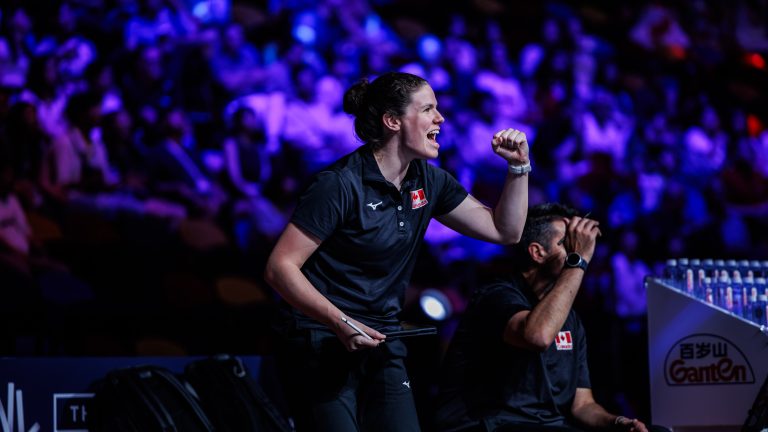
As more women take on coaching roles at the highest level of volleyball, Canada’s Carolyn O’Dwyer believes the conversation must go beyond representation. For the Team Canada assistant coach, lasting progress depends on building stronger coaching pathways that provide women with the support, experience and opportunities needed to develop throughout their careers.
Coaching the Canadian national team is the culmination of a journey that began within the very pathway that O’Dwyer now hopes to strengthen.
“It’s always been a goal of mine to coach at the international level, having previously played and developed through the Team Canada pathway,” she said. “Previously, my role with Volleyball Canada was with the youth teams, and I was also the head coach of our National B Team. I’m incredibly passionate about the growth and development of volleyball in Canada, so a huge motivation for me was to see Canada continue to succeed on the world stage and to contribute to that growth.
“I also had the opportunity to work with Giovanni, who is one of the best coaches in the world, and that was a tremendous learning and development opportunity that I wanted to take advantage of. Those were the two main motivations for me.”

That pathway was strengthened by the FIVB Coach Initiative, which gave O’Dwyer the opportunity to dedicate herself fully to coaching while continuing to develop Canada’s national team programme. Rather than simply opening one door, she believes the programme created an environment where she could continue growing as a coach while helping others do the same.
“The initiative has definitely influenced my opportunities, particularly from a financial perspective. In my previous role coaching our youth teams and serving as head coach of the National B Team, the FIVB’s support allowed that to become a full-time position, giving me the opportunity to focus on my development and growth as a coach while helping to develop our national team pathway,” she said.
“That has made a huge impact. I also had the opportunity to work with Shannon Windsor, who was the head coach of Team Canada at the time and is now our High Performance Director. I believe she also benefited from the FIVB initiative, and I think that has indirectly contributed to my own development. She has been a tremendous supporter of my growth and success as a coach.”
Today, O’Dwyer is helping Canada continue its rise on the international stage, something she has long believed the programme was capable of achieving.
“Being part of this national team and this campaign has been amazing. It has showcased what Canada is capable of on the world stage. I’ve always believed we could be a very strong nation, and to see that becoming a reality and to witness success at this level has been incredible to be part of.”

While O’Dwyer believes great coaching is defined by competence, communication and a commitment to athlete development rather than gender, she also sees unique strengths that women bring to coaching environments.
“Yes, I do think a coach’s gender can influence team dynamics. Ultimately, athletes want a coach who will help them improve. They want someone with strong technical and tactical volleyball knowledge, someone who cares about their development and communicates well. Those qualities can exist in both male and female coaches. However, I believe female coaches have a significant advantage in understanding women and the dynamics within a women’s team because we don’t have to imagine what it’s like,” she explained.
“We’ve lived those experiences ourselves. I think that’s a major strength, particularly when it comes to the psychological and emotional aspects of coaching, and it’s something that should be valued because it has a real impact on relationships with athletes.”
Creating more women coaches, however, requires more than visibility at the elite level. O’Dwyer believes opportunities must exist throughout the coaching pathway, beginning with practical experience and supported by mentors who can help guide the next generation.
“The message I would give to young women has three parts. First, coach as much as you can and look for every opportunity to coach. You’ll develop your craft by doing, by making mistakes, and by learning from those experiences. Take every opportunity you can.
“Second, find a mentor or several mentors. It’s so important to have people who support you, understand coaching, can help with your development, and have already been where you are or where you hope to go in the sport.
“Third, coaching is an incredibly rewarding career. It can be challenging at times, requiring sacrifices such as time away from family, friends, and extensive travel. But ultimately, it’s a profession where you see tremendous growth in athletes and in yourself. I would encourage young women to pursue coaching and embrace the opportunity.”

The assistant coach believes success will not simply be measured by seeing more women on coaching benches. It will come when women are consistently part of coaching staffs, when opportunities exist throughout the professional game, and when those pathways lead to success on volleyball’s biggest stages.
“I think there are several factors that would demonstrate success for women in coaching. First, we should consistently see women serving on coaching staffs, whether as head coaches or assistant coaches, at the international level and on the biggest stages, such as the Volleyball Nations League and the World Championships. It shouldn’t be about filling a gender quota. It should simply become normal for women to be part of coaching staffs.” she said.
“Second, it’s important to continue developing the pipeline of women coaches rather than focusing only on the highest level. Success at the FIVB level starts with opportunities throughout the year. If women are going to coach national teams, they also need opportunities to coach professionally year-round. We need to prioritise that across the professional game worldwide.
“Finally, success will also be reflected in results. In the coming years, I hope we see women coaches succeeding on the podium, whether at the Volleyball Nations League, the Olympic Games, or the World Championships. Seeing women serving as head coaches or assistant coaches at the highest level and achieving success will clearly demonstrate the impact they have on the game.”